


Better Cities Project
  • Home
  • About Us
    Our Vision
    BCP’s vision is that free-market municipal policy solutions are broadly available, widely acceptable, and regularly employed, enabling American cities to achieve their full potential as engines of economic prosperity. We reject the idea that cities are lost to free-market principles or policies.
    Our Mission
    BCP uncovers ideas that work, promotes realistic solutions, and forges partnerships that help people in America’s largest cities live free and happy lives.
    Learn More
    • About Better Cities Project
    • Our Focus Areas
    • Our Team
    • Collaboration and Careers -- Work With BCP
  • Research and Projects
  • Latest Insights
  • Videos
  • Contact

    Address

    304 S. Jones Blvd #2826
    Las Vegas NV 89107

    Phone

    (702) 608-2046‬

    Hours

    Monday through Friday, 8 a.m. - 5 p.m.

    Email

    info@better-cities.org

No Result
View All Result
Better Cities Project
  • Home
  • About Us
    Our Vision
    BCP’s vision is that free-market municipal policy solutions are broadly available, widely acceptable, and regularly employed, enabling American cities to achieve their full potential as engines of economic prosperity. We reject the idea that cities are lost to free-market principles or policies.
    Our Mission
    BCP uncovers ideas that work, promotes realistic solutions, and forges partnerships that help people in America’s largest cities live free and happy lives.
    Learn More
    • About Better Cities Project
    • Our Focus Areas
    • Our Team
    • Collaboration and Careers -- Work With BCP
  • Research and Projects
  • Latest Insights
  • Videos
  • Contact

    Address

    304 S. Jones Blvd #2826
    Las Vegas NV 89107

    Phone

    (702) 608-2046‬

    Hours

    Monday through Friday, 8 a.m. - 5 p.m.

    Email

    info@better-cities.org

No Result
View All Result
Better Cities Project
No Result
View All Result
Home Economic Prosperity

The stadium subsidy debate is over and economists have moved on

Policymakers should stop pretending there is ambiguity about public returns

Patrick TuoheybyPatrick Tuohey
February 9, 2026
in Economic Prosperity
Reading Time: 3 mins read
A A
The stadium subsidy debate is over and economists have moved on

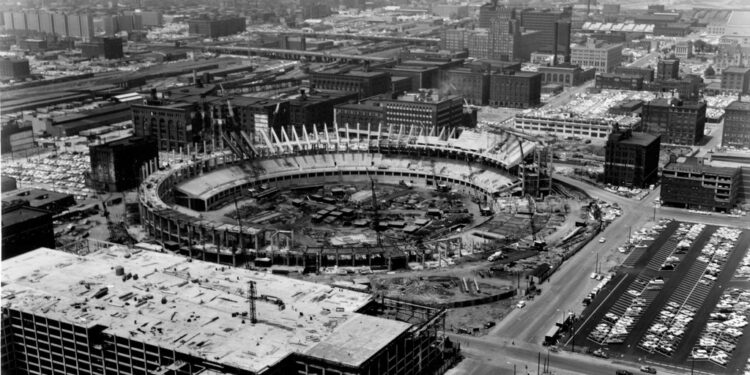
Construction of Busch Stadium in St. Louis, 1965

Share on FacebookShare on TwitterLinkedInEmail
Local governments still face a familiar pitch: a new stadium or arena will “revitalize” a district, grow the tax base, and pay for itself. The details vary. The conclusion rarely does. Public dollars are treated as the spark that will finally unlock private investment.

The problem is that economists have been testing that promise for decades, and the results have not been kind to the pitch. In a forthcoming Economic Development Quarterly reply, John Charles Bradbury and Brad Humphreys put it plainly: “it is accurate to describe the academic consensus as generally opposed to public underwriting of professional sports venues.”

That sentence matters for policymakers because stadium deals often proceed as if the research is unsettled. Bradbury and Humphreys are responding to a commentary by Johnson, Fort, and Rosentraub (2025) arguing that the “consensus” framing is overstated and that governments should weigh costs and benefits project by project. Bradbury and Humphreys’ response is direct: “their recommendation that proposed venue projects need to be evaluated on a case-by-case basis is not backed by available evidence.”

RelatedInsights

Can Kansas really afford this stadium?

The math doesn’t work: Kansas’ STAR bonds alone can’t fund a Chiefs stadium

What cities can learn from the backlash against data centers

Denver study shows removing parking requirements results in more affordable housing being built

One reason this debate keeps looping is that proponents lean on two ideas that sound reasonable in isolation. First, even if stadiums do not boost “regional economic activity” much, they might create civic pride and quality-of-life benefits. Second, even if many past projects disappointed, the next one could be different.

The paper tackles both.

Start with the consensus question. Bradbury and Humphreys note two prominent surveys of economists showing overwhelming skepticism. In a 2005 survey of American Economic Association members, 85% agreed that state and local governments should eliminate subsidies to professional sports franchises. A 2017 University of Chicago economics panel survey found 80% agreement that stadium subsidies are likely to cost taxpayers more than the local economic benefits generated. The commentary they rebut questions sample size and wording. Bradbury and Humphreys argue those critiques do not land, noting the caliber of the respondents and the lack of a clear mechanism for systematic bias.

Next, the “intangibles” argument. Policymakers hear it constantly: even if the economic impact is small, residents value having a major league team and a signature venue. Bradbury and Humphreys’ key point is not that intangible benefits are zero. It is that they are typically far smaller than the public price tag. Their summary line is hard to misread: “academic studies indicate that the sum of tangible and intangible benefits are typically too small to justify government underwriting of professional sports stadium projects.”

That framing helps policymakers avoid a common rhetorical trap. A stadium can produce real amenities and still be a poor public investment at the scale of modern subsidies. Bradbury and Humphreys also emphasize that spillovers are not uniform across communities and that some research finds negative externalities like crime, congestion, and other disamenities that can offset the positives.

Then comes the “just study it harder” move. In principle, careful benefit-cost analysis is a good habit. In practice, stadium debates rely on forward-looking projections commissioned by interested parties, built on discretionary assumptions. Bradbury and Humphreys warn against treating those forecasts as neutral evidence, writing: “The track record of forward-looking benefit-cost/fiscal impact analyses that accompany nearly all stadium projects has been one of consistent failure.”

This is where the national lesson becomes practical. Cities are often told to negotiate a better deal, demand more community benefits, or commission another consultant report. Those steps can improve transparency. They do not change the base rate: stadium subsidies rarely generate net public returns.

Bradbury and Humphreys close by putting the burden where it belongs. If a public subsidy is being proposed, the default assumption should not be that it “might work this time.” It should be that it probably will not, unless proven otherwise. As they write, “The state of current research findings is so united in opposition that the burden of proof rests squarely on subsidy proponents to provide robust evidence using established economic research methods to demonstrate the feasibility of any public stadium proposal.”

None of this requires hostility toward sports. It requires candor about what public dollars are buying. If a city wants a stadium as a consumption amenity, officials can say so and let voters judge the tradeoff. What cities should stop doing is calling stadium subsidies “economic development” when the research record says otherwise.

Tags: Economic DevelopmentEconomicsResearchSports Subsidies
Previous Post

Beyond the spectacle, Kansas City prepares for World Cup reality

Patrick Tuohey

Patrick Tuohey

Patrick Tuohey is co-founder and policy director of the Better Cities Project. He works with taxpayers, media, and policymakers to foster understanding of the consequences — sometimes unintended — of policies such as economic development, taxation, education, and transportation. He also serves as a senior fellow at Missouri's Show-Me Institute and a visiting fellow at the Virginia-based Yorktown Foundation for Public Policy.

Explore More

  • Economic Prosperity
  • Criminal Justice and Public Safety
  • Transportation and Infrastructure
  • Education
  • Energy and Environment
  • Community, Growth and Housing
  • Clean, Open and Fair Government

Recent News

The stadium subsidy debate is over and economists have moved on

The stadium subsidy debate is over and economists have moved on

February 9, 2026
Could the World Cup really bring a touted $653 million to KC? Be skeptical

Beyond the spectacle, Kansas City prepares for World Cup reality

February 5, 2026
Could the World Cup really bring a touted $653 million to KC? Be skeptical

Could the World Cup really bring a touted $653 million to KC? Be skeptical

February 5, 2026
Texas HB 24: A win for housing development—and a lesson for other cities

Why the housing shortage defies easy math—and what cities can do about it

February 5, 2026
Load More
Facebook Twitter RSS
Better Cities Project

BCP helps local leaders leverage public policy to create freer and happier communities. We uncover what works, promote solutions, and forge partnerships that turn ideas into results.


© 2025 Better Cities Project

Our Focus Areas

  • Economic Prosperity
  • Criminal Justice and Public Safety
  • Transportation and Infrastructure
  • Education
  • Energy and Environment
  • Community, Growth and Housing
  • Clean, Open and Fair Government

The Fine Print

  • Privacy Policy
  • Terms and Conditions
  • Reports and Financials

Recent News

The stadium subsidy debate is over and economists have moved on

The stadium subsidy debate is over and economists have moved on

February 9, 2026
Could the World Cup really bring a touted $653 million to KC? Be skeptical

Beyond the spectacle, Kansas City prepares for World Cup reality

February 5, 2026
Could the World Cup really bring a touted $653 million to KC? Be skeptical

Could the World Cup really bring a touted $653 million to KC? Be skeptical

February 5, 2026

Welcome Back!

Login to your account below

Forgotten Password?

Retrieve your password

Please enter your username or email address to reset your password.

Log In

Add New Playlist

Love Cities? So Do We.

Get ahead of the curve -- learn about innovations, ideas and policies driving change in America's largest cities, with BCP in your inbox.


You have Successfully Subscribed!

No Result
View All Result
  • About Us
  • The Team
  • Work With Better Cities Project
  • Research and Projects
  • Latest Insights
  • Videos

© 2025 Better Cities Project