


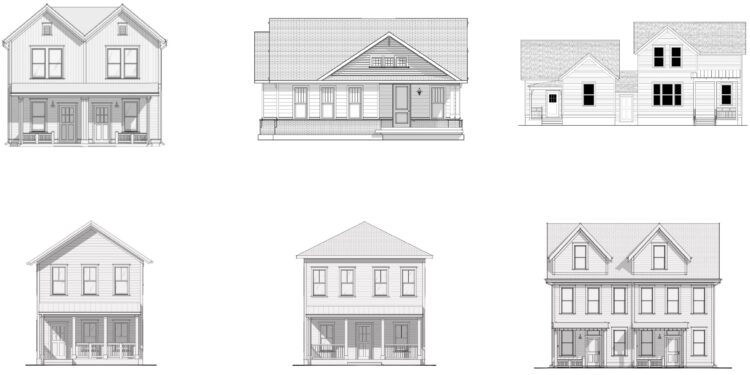
Overland Park’s Portfolio Homes program offers a catalog of city-reviewed single-family house plans intended to streamline the local permitting process. The plans are available at no cost and, according to local reporting, permit fees are waived when builders use them. The city still requires a permit application and final approval, but much of the design review is handled upfront, reducing both time and uncertainty. Local coverage, including reporting by The Kansas City Star and KCTV5, describes the program as a response to resident demand for more attainable housing options and faster approvals.
This distinction matters: the program retains oversight and professional involvement. It narrows the scope of review by resolving compliance questions in advance. Builders can still choose custom designs, but those who opt into the portfolio face fewer procedural hurdles. That makes the program voluntary, additive, and politically easier to sustain.
Nationally, this approach remains uncommon. Planning organizations and housing advocates note that only a limited number of U.S. municipalities have formal pre-approved plan catalogs. There is no authoritative national inventory, but groups such as the Congress for the New Urbanism and Strong Towns point to several dozen local examples, most created within the last few years. The vast majority of American cities still rely on traditional, case-by-case plan review for every new home.
Where pre-approved plans do exist, they tend to be narrow in scope. Many cities focus on accessory dwelling units, which are easier to standardize and often encouraged by state policy. West Coast cities like Santa Ana and Long Beach offer pre-approved ADU designs intended to cut design costs and shorten approval timelines. Local news outlets in California have reported on these programs as part of a broader effort to boost small-scale housing production.
A smaller number of Midwestern cities are testing broader catalogs. South Bend, for example, maintains a set of pre-approved building plans aimed at supporting infill and missing-middle housing types. Planning advocates have highlighted South Bend’s program as a way to reduce friction for small builders while maintaining local code standards.
Seen in that context, Overland Park stands out less for inventing a new idea than for applying it in a conventional suburban setting. Rather than limiting pre-approval to backyard units or pilot infill projects, the city extended the concept to detached, market-rate homes. That choice signals that pre-approved designs are not just a niche ADU tool, but a general process reform.
Support from the local building industry reinforces that point. The Home Builders Association of Kansas City publicly commended the Portfolio Homes initiative, with its executive vice president praising the program for aligning with demand for smaller homes and for reducing costs through free plans and waived fees. Industry backing does not guarantee success, but it does suggest the program addresses real bottlenecks rather than theoretical ones.
Advocates argue that pre-approved plans offer predictability in a permitting environment that often lacks it. By resolving code compliance questions upfront, cities can reduce delays that add carrying costs and risk to housing projects. While hard data on cost savings remains limited and context-specific, planning research and case studies consistently point to shorter approval timelines in jurisdictions that adopt these tools.
There are limits. Pre-approved plans do not override restrictive zoning, nor do they substitute for infrastructure investment. Cities that prohibit small lots or modest homes will see little benefit. And because these programs are typically created by ordinance or administrative action, they can be revised or repealed over time.
That flexibility, however, is also a strength. Pre-approved design programs are locally controlled, relatively low-cost to implement, and easy to pilot. They allow cities to experiment with process reform without mandating outcomes or rewriting entire zoning codes.
For policymakers across the country, the lesson from Overland Park is not that every city should copy its exact plans. It is that cities should reconsider why they repeatedly review the same code-compliant designs as if each were novel. When planning organizations can already point to several dozen working examples, the more pressing question is why this approach remains the exception rather than the norm.
Pre-approved plans aren’t a cure-all, but they help cities remove self-imposed construction barriers—one permit at a time.