

The usual debate is over whether those incentives are too generous, too costly or unfair to taxpayers who do not receive them.
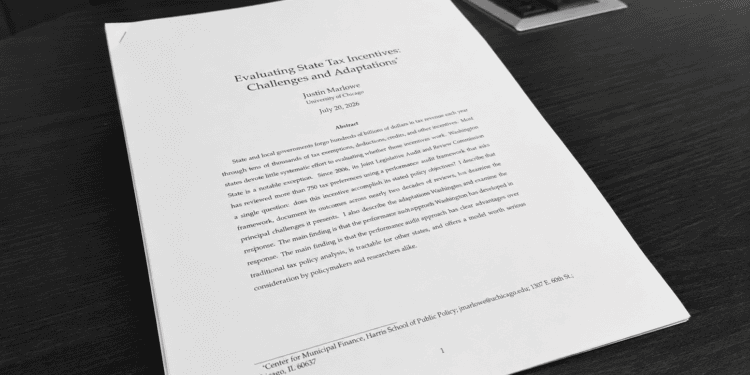
Justin Marlowe of the University of Chicago asks a more basic question in his paper, “Evaluating State Tax Incentives: Challenges and Adaptations:” how do we know whether these programs do what lawmakers say they are supposed to do?
Washington State has spent nearly two decades trying to answer that question. Since 2006, its Joint Legislative Audit and Review Commission has reviewed hundreds of tax preferences using a performance-audit framework. Rather than beginning with an estimate of how much revenue a tax break costs, evaluators begin with the stated policy objective and ask whether the incentive accomplished it.
That sounds like a low bar. Marlowe’s paper shows that it is not.
In 68% of Washington’s full reviews, lawmakers had not clearly stated the objective of the tax preference when they created it. Evaluators had to infer the purpose from statutory language, legislative history and other evidence. Only two incentives in the review record included measurable performance metrics.
That finding may be the most important in the paper.
A tax incentive cannot be evaluated very well if no one says in advance what success looks like. “Create jobs,” “promote development” and “support an industry” sound like goals, but they leave enormous room for interpretation. How many jobs? Compared with what? Would the investment have happened anyway? How long should the benefit last? What result would justify ending the program?
Without answers to those questions, almost any outcome can later be presented as evidence of success.
Washington eventually began requiring new tax preferences to include performance statements identifying their purpose and public-policy objective, along with measurable metrics where applicable. That does not settle every argument over subsidies, but it changes the starting point.
The state’s experience also offers a useful warning. Evaluation is not the same thing as reform.
Washington auditors often recommend continuing a tax preference or asking the legislature to clarify its purpose. Recommendations to terminate or allow incentives to expire are less common. And even when auditors conclude that a preference should end, lawmakers do not always follow their advice.
That should not be surprising. Once a subsidy exists, it develops beneficiaries. Those beneficiaries have an obvious reason to defend it, while the cost is spread among taxpayers who may have little idea the program exists.
This may help explain another of Marlowe’s findings. Washington’s review system appears to have had its greatest influence before new incentives are enacted. More recent tax preferences are far more likely than older ones to include expiration dates.
That matters because it is easier to require accountability when a program is created than to dismantle it later. A sunset clause does not guarantee that an ineffective subsidy will disappear. Legislatures can extend programs, and politically powerful beneficiaries can still win favorable treatment. But an expiration date at least forces lawmakers to revisit the question.
Much of economic-development policy still works in the opposite direction. A project is announced. Consultants produce estimates of jobs, investment and tax revenue. Public officials approve an incentive package. Years later, when someone asks whether the subsidy actually produced the promised results, the answer is often difficult to determine.
The problem is not always that officials are hiding something. Sometimes the information was never collected. Sometimes no one agreed on the relevant measure. Sometimes the original goals were so broad that there is no meaningful way to judge the outcome.
Washington’s experience suggests a better approach: Before approving a subsidy, lawmakers should identify the public purpose, establish measurable criteria, require the necessary data, provide for independent evaluation and set a date when the program will expire unless it is affirmatively renewed.
I asked Marlowe whether the same approach could be applied to individual economic development deals, such as TIF or negotiated tax abatements. He said the answer is yes, but with an important caveat: evaluating individual local incentives is much harder.
Statewide programs can sometimes be evaluated by comparing states, regions or industries, or by measuring results before and after an incentive takes effect. A single project offers fewer opportunities to determine what the subsidy actually caused and may require more detailed data than evaluators can obtain.
That does not make evaluation pointless. For a project-specific incentive, officials can still determine why public assistance is necessary, establish what level of new investment and how many net new jobs are expected, identify what data will be collected and decide how the results will be judged. Those questions should be answered before the deal is approved, not invented after the fact.
The independence of the evaluator matters, too. Economic development agencies are usually charged with attracting investment and administering incentive programs. Many are funded through fees that are collected from approved projects. That does not make them dishonest, but it does create an institutional tension when they are also expected to judge whether their own programs succeeded. Washington places much of this work with a legislative audit body that operates under professional auditing standards.
Marlowe does not present Washington as a perfect model. Evaluators still encounter poor data, vague legislative intent and political resistance. Some large tax preferences receive less scrutiny than their fiscal size would seem to warrant. And a good audit cannot force a legislature to act.
But the paper points toward a useful standard for states that continue to use tax incentives.
They do not have to resolve the larger ideological argument over whether subsidies are good or bad. They can begin with something more practical: define the purpose, decide how success will be measured, review the results independently and require lawmakers to reconsider the program after a fixed period.
A subsidy that cannot fail a meaningful test is not really being evaluated. Governments should be careful about spending money on programs they have no way to judge.